Lan Dong’s Mulan’s Legend and Legacy in China and the United 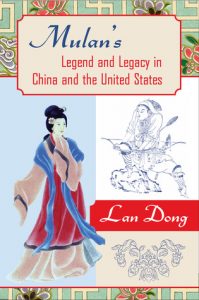 Statesdepicts the evolution of the woman warrior Mulan, contextualising her away from the Disney palimpsest, within the frameworks of her origins in Chinese literature.
Dong leads us through thought-provoking chapters on the woman warrior, the lady knight-errant, Mulan as a virtuous icon and an inspired vision of Maxine Kingston’s collection The Woman Warrior. Additionally, the final two chapters show a depth in research considering alternative modes of literature, such as, picture books and the more controversial animations that preceded Disney’s Mulan.
As a society in the western world, we have been tricked into believing that Mulan was always a feminist icon. Disney’s Mulan has enabled this belief with its questionable feminist portrayal of Mulan seeking independence as a woman. Lan Dong unravels the literary journey with her reading of not only, the original text but also the later renditions. Mulan’s cross-dressing and subsequent trespass into the male dominated sphere of the war zone was ignored and viewed without the contempt it later faced. Dong reveals that this is due to the overpowering key attribute of filial loyalty accepted in Confucianism. Mulan goes to war for her father in many renditions of the story. Her act is out of familial love. The trespass is dismissed, thus, becoming traditionally acceptable due to Mulan’s motives.
Yet why is it that when we watch Disney’s Mulan filial loyalty isn’t what we predominantly relate to? Yes, it is a crucial factor, but it’s not at the height of our analyses. Dong exposes these questions, problematising the view we see as a western audience. In her chapter, ‘Of Animation and Mulan’s International Fame’, she explores the bemused view of Disney’s Mulan in the mainland of China. Dong interrogates the legend’s evolution, poignantly evoking the hybridity of Disney’s Mulan, divulging pertinent questions. For example, she considers whether the evolution is in fact a modification. There is a fine line to toe there, but perhaps the western world, in trying to carefully present the legend of Mulan to an international audience, have modified and therefore reconstructed a large part of what endears the original legend to the Chinese public. The western world has diminished the idea of filial loyalty and have instead raised the question of female independence.
But can we really say that the western world deserved to change this aspect. I could play devil’s advocate here and say that Disney have turned the legend of Mulan into something we all love. I’ll leave it to you to decide whether the changes were worth it or not, at your own costs.
Lan Dong’s Mulan’s Legend and Legacy has truly been an eye-opener. It’s an informed text which questions, intrigues and answers. As a “hybrid” person stuck between two worlds it really made me consider whether I would be happy to see a story from my heritage so changed, maybe not in plot, but so overtly in feeling. Lan Dong’s Mulan’s Legend and Legacygives back explanations to those feelings from Chinese culture, exploring a rich literary history to a story we all love and cherish.


Leave a Reply